


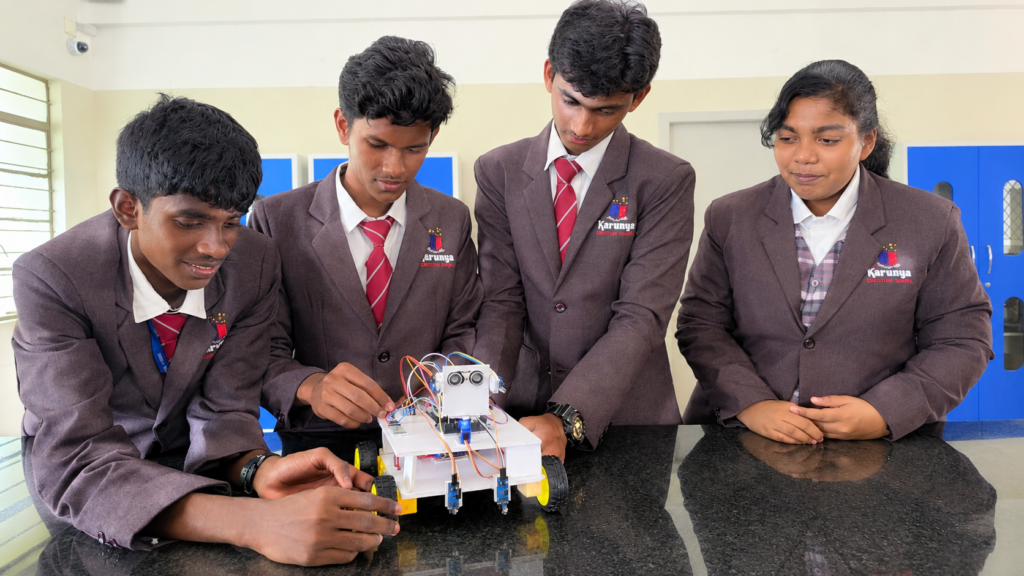
Education involves more than completing lessons and remembering information. Students also need opportunities to participate, experiment, and put their knowledge to use. Practical learning brings these experiences into school education through activities that encourage students to take part in their lessons.
From classroom demonstrations to subject-based projects, these activities give students a different way to engage with their studies. They also allow teachers to make lessons more interactive and connect teaching methods with students’ learning needs.
Why Is Practical Learning Important in School Education?
Practical learning helps students move from memorising information to understanding how and why things happen. It gives them a chance to test what they have studied and see whether their understanding matches the results.
It also helps students approach difficult topics. A mathematical formula, a scientific principle, or a grammatical rule can be easier to understand when students work through an activity related to it. They can follow each step, notice patterns, and identify where they need more explanation.
Another benefit is that students learn to take an active role in their studies. They make observations, discuss their findings, and explain their reasoning. Over time, this can improve their ability to think independently and use their knowledge to answer questions.
How Does Practical Learning Help Students Understand Academic Concepts?
Some topics can be difficult for students to picture or understand through verbal explanations. Practical learning gives teachers ways to demonstrate these ideas and help students follow how they work.
For example, a geometry lesson can use physical shapes to explain angles, area and volume. In science, a simple experiment can demonstrate how heat affects different materials. In language classes, role-play can help students understand dialogue, sentence construction and communication.
These methods give students a reference point when they return to the concepts in their textbooks. They can recall what they observed or did and relate it to the lesson. This connection can make unfamiliar topics easier to follow and remember.
Practical learning also reduces the need for students to rely on memorisation alone. When they understand the reason behind a formula, scientific principle, or language rule, they can explain it in their own words. This helps them remember concepts for longer and apply their knowledge when answering different types of questions.
What Are the Benefits of Practical Learning for School Students?
Practical learning contributes to several areas of a student’s development. Along with academic understanding, it helps students build abilities that are useful in their studies and everyday interactions.
- Improves critical thinking: Students learn to examine information, compare results, and consider different ways to approach a task.
- Develops problem-solving skills: Activities and projects encourage students to identify challenges and work towards suitable solutions.
- Builds teamwork: Group experiments and classroom projects teach students to share responsibilities, listen to others and work together.
- Improves communication: Explaining observations, discussing ideas, and sharing findings help students express themselves more effectively.
- Encourages curiosity: Practical activities give students opportunities to investigate topics, ask questions, and learn more about subjects that interest them.
How Can Practical Learning Be Included in Different Subjects?
Practical learning can be part of almost every school subject. Teachers can select activities based on the topic, age group, and learning objectives.
- Mathematics: Measurement exercises, geometry models and classroom calculations help students work with numbers and mathematical principles.
- Science: Laboratory experiments, nature observations and simple demonstrations introduce students to scientific processes.
- Social Science: Map activities, historical timelines, role-play and educational visits help students study people, places and events.
- English: Storytelling, debates, reading activities and role-play give students opportunities to practise language and communication.
- Computer Science: Coding exercises, basic programming tasks and digital projects introduce students to computing concepts.
The activities need not always involve specialised equipment or laboratories. Teachers can use classroom materials, everyday objects and group tasks to make lessons more interactive.
How Does Karunya Christian School Encourage Practical Learning?
At Karunya Christian School (KCS), practical learning is part of the school’s approach to teaching. The school follows an inquiry-based learning approach that encourages students to engage with their subjects and take an active part in classroom activities. Technology-supported teaching and well-equipped laboratories provide additional ways to study different topics.
The Physics, Chemistry, and Biology laboratories allow students to carry out experiments related to their science lessons. In the computer laboratories, students learn software applications and programming at different levels. They also complete projects and assignments that help them apply their computer knowledge.
Smart classrooms use audio-visual teaching aids to support explanations and demonstrations. The school library also gives students access to reference books, periodicals, science journals, and multimedia resources for further reading and research.
These academic resources support the school’s CBSE curriculum and give students different ways to engage with their studies. This approach to teaching, supported by academic facilities and individual attention, is part of what positions Karunya Christian School among the best CBSE schools in Coimbatore.
Conclusion
Practical learning gives school education a valuable dimension by allowing students to engage with ideas through activities and direct participation. When classroom teaching includes opportunities to apply knowledge, students can build a stronger understanding of their subjects rather than depend only on memorisation.
At Karunya Christian School, this approach forms part of the learning experience. The school aims to help students make the most of their academic years through a combination of classroom instruction and practical learning.